
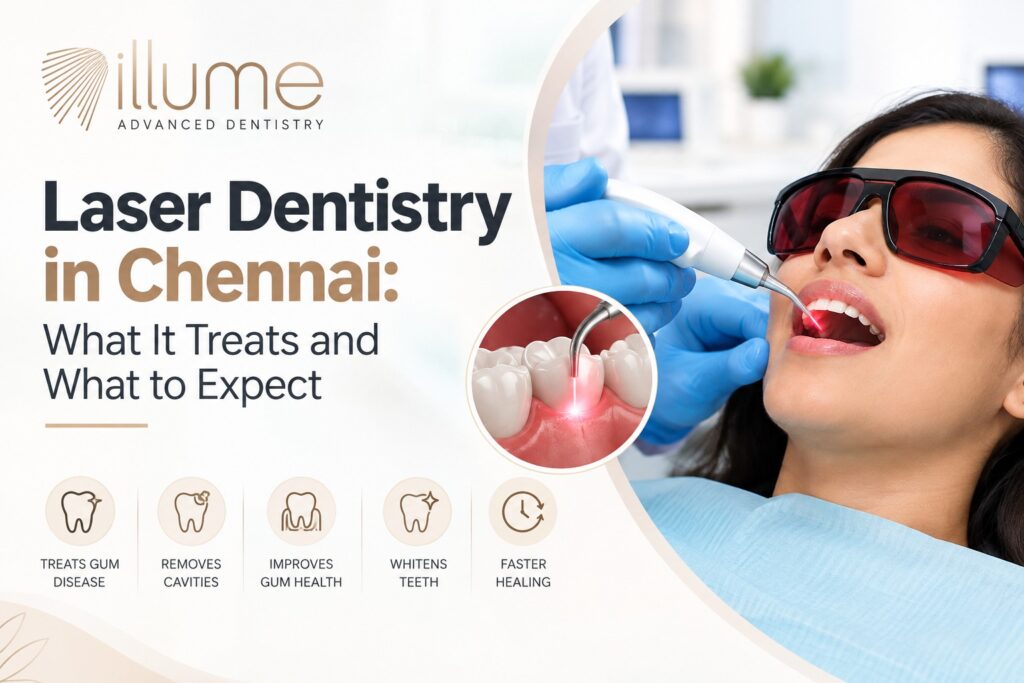
Laser dentistry uses a focused beam of light energy to treat teeth and gums. At Illume Advanced Dentistry in Nungambakkam, Chennai, Dr. Jerry Joe and the team use dental lasers for selected gum and soft-tissue procedures, so that many patients need less cutting, fewer stitches and often less discomfort. This guide explains what laser dentistry is, what it can treat and what to expect.
What is laser dentistry?
Laser dentistry is the use of a dental laser to reshape gum tissue, remove diseased tissue or prepare a tooth. The laser delivers light energy in a very small, controlled area. Depending on the type of laser, it can work on soft tissue (gums), hard tissue (tooth structure) or both.
What can laser dentistry treat?
- Gum disease: lasers can help remove infected gum tissue and clean the area around the tooth as part of periodontal care. See our page on gum disease treatment in Chennai.
- Gum reshaping: uneven or excess gum tissue can be contoured to improve how a smile looks, for example a “gummy” smile.
- Tissue attachments: a tight tongue-tie or lip-tie can be released with a laser in a short procedure.
- Small soft-tissue problems: some ulcers, overgrowths and biopsies can be handled with a laser.
- Tooth sensitivity and cavity preparation: certain lasers can be used to treat sensitive areas or prepare a tooth for a filling, depending on the case.
How does a laser dental procedure work?
- Examination: the dentist checks your teeth and gums and confirms that a laser is suitable for your case.
- Comfort: a local anaesthetic or numbing gel is used when needed, and many soft-tissue procedures need little or none.
- Treatment: the laser is directed at the target area for a short time. The dentist controls the depth carefully.
- Aftercare: you receive simple instructions, such as keeping the area clean and avoiding very hot or spicy food for a few days.
What are the possible benefits?
- Less bleeding during soft-tissue procedures, because the laser can seal small blood vessels.
- Often fewer or no stitches.
- Many patients report less discomfort and quicker healing than with a scalpel, though this varies from person to person.
- A precise, controlled treatment area.
Is laser dentistry right for everyone?
Not always. Lasers suit some treatments very well but cannot replace every dental procedure. Deep decay, large fillings, root canal treatment, crowns and implants still use conventional methods. Your dentist will explain whether a laser is a good option after an examination.
Frequently asked questions
Is laser dentistry painful?
Most patients find it comfortable. The dentist uses numbing where needed, and many soft-tissue laser procedures cause little discomfort. Sensitivity afterwards is usually mild and short-lived.
Is laser dentistry safe?
Dental lasers are used routinely when handled by a trained dentist, and the team follows standard safety steps such as protective eyewear. Your dentist will tell you if a laser is not suitable for you.
How long does healing take?
Healing depends on the procedure. Small gum procedures often settle within days to a couple of weeks. Your dentist will tell you what to expect.
Does a laser replace a dental drill?
Only in some cases. Lasers can prepare certain small cavities, but many treatments still need traditional instruments.
Can laser treatment help bleeding gums?
It can be part of treatment for gum disease, but the cause of the bleeding must be found first. Read more in our guide to bleeding gums: causes and treatment, or learn about seeing a periodontist in Chennai.
Learn more or book a visit
To find out whether laser treatment suits you, see our dental laser treatment in Chennai page, or book an appointment with Dr. Jerry Joe at Illume Advanced Dentistry, Nungambakkam.